काठमाडौं ।
Digital literacy, rather than mobile broadband coverage, has emerged as one of the biggest barriers keeping billions of people offline, with Huawei’s community-based digital skills initiatives highlighted as a potential model for closing the gap and unlocking trillions of dollars in economic value.
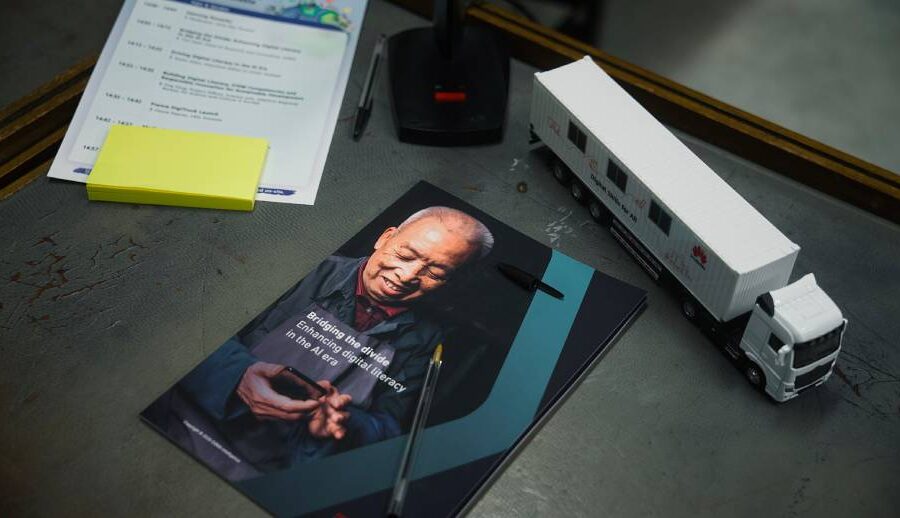
A new report, Bridging the Divide: Enhancing Digital Literacy in the AI Era, authored by GSMA Intelligence in collaboration with Huawei and released during UNESCO’s Digital Learning Week, estimates that 3.1 billion people remain digitally excluded despite living in areas covered by mobile broadband.
According to the report, mobile broadband coverage now reaches 96% of the world’s population, but more than one in three people covered by mobile networks remain offline. The gap is increasingly linked to a lack of digital skills, user trust and the ability to use emerging technologies such as artificial intelligence.
The report says closing the digital capability gap could add around $3.5 trillion to global GDP between 2023 and 2030, with more than 90% of the potential economic gains expected to flow to low- and middle-income countries.
Huawei’s contribution is highlighted through its Skills on Wheels initiative, which uses mobile classrooms to deliver digital skills training to underserved communities, particularly in rural and remote areas.
A key component of the initiative is Huawei’s solar-powered DigiTruck mobile classroom. The units bring digital equipment, connectivity and hands-on training directly to communities that may lack access to traditional training facilities. The programs also include training in AI literacy.
Since 2019, Skills on Wheels projects have delivered training to more than 130,000 people across 21 countries, with additional people benefiting indirectly as trainees share their skills with family members and peers.
A report by Kenya’s Ministry of Information, Communications and Digital Economy found that 79% of surveyed DigiTruck trainees had passed on their newly acquired digital skills to family members and peers.
The GSMA Intelligence report identifies community-based learning as an important approach to reaching people most at risk of digital exclusion, including rural communities, children and teachers in rural schools, older people, and women and girls.
The report also warns that the rapid adoption of AI could widen the digital divide if people do not receive adequate training. At the same time, AI could help reduce some barriers to technology use.
AI-powered voice assistants and applications that use images, audio and video can allow people with limited literacy or typing skills to interact with digital services without relying heavily on text. However, users also need to understand data privacy and be able to recognize online risks, including fraud and deepfakes.
The report cites World Bank data showing that generative AI literacy is becoming a high-value skill category, with wage premiums of up to 36%, significantly higher than returns associated with digital and traditional AI skills.
Without targeted investment in basic digital training, the report warns that rapid AI adoption could reinforce existing inequalities, even in communities with access to high-speed networks.
To close the digital usage gap, the report calls on governments, telecom operators and technology companies to work together on four priorities: making practical AI awareness, online safety and information verification part of basic national qualifications; expanding multilingual voice and conversational interfaces in public services; scaling up mobile learning units through partnerships between telecom operators, technology vendors and local organizations; and measuring training success through practical task completion and resilience against fraud rather than simply counting trainees.
“Digital literacy can no longer be defined by static thresholds,” said Tim Hatt, head of research and consultancy at GSMA Intelligence. “Connectivity alone is insufficient — capabilities, system design and trust must evolve together. To capture this multi-trillion-dollar opportunity, stakeholders must integrate layered AI literacy directly into daily livelihoods through trusted community channels.”
Huawei said its mobile classroom programs would continue to focus on underserved communities as the global economy moves toward greater use of AI.
“Mobile classrooms have demonstrated immense value in helping underserved populations break through physical and psychological barriers to technology,” said Gavin Allen, Executive Editor-in-Chief at Huawei. “We will continue working alongside local governments and industry partners to drive digital literacy, ensuring that no one is left behind as we transition into the AI economy.”
The initiative is also expanding in Europe. A new DigiTruck program is scheduled to launch in France this autumn, covering several cities in the Île-de-France region and providing digital skills training to low-income and underserved communities.
The report argues that closing the digital divide will require more than expanding network coverage. As AI becomes increasingly integrated into work, education and everyday services, digital and AI literacy will become essential for people to participate safely and effectively in the digital economy.
प्रकाशित: २५ भाद्र २०८३, बिहीबार