काठमाडौं ।
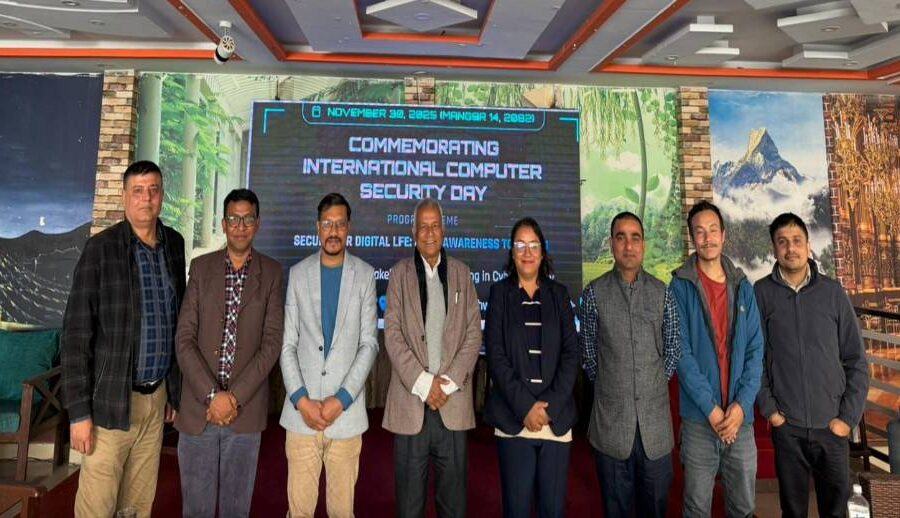
A Multi Stakeholder Group Working on Cyber Security successfully hosted a crucial event to commemorate International Computer Security Day. Organized in a remarkably short time (under 20 hours), the gathering united the nation’s foremost experts from government, industry, and academia with the singular, defining theme: “Secure Our Digital Life: From Awareness to Action.”
The overarching consensus reached by the participants was the immediate need to broaden the focus from general computer security to a comprehensive, sustained approach to Information Security across the entire nation.
The day is observed globally as International Computer Security Day, a tradition established by the Association for Computing Machinery (ACM) in 1988. This date was chosen as a permanent global wake-up call following the notorious Morris Worm—the first major malware—which infected approximately 10% of all connected computers, necessitating a moment each year to pause and evaluate digital hygiene against modern threats.
Suvash Khadka, Member, National Cyber Security Policy Implementation Committee; Vice President, CAN Federation; CEO, ISP Association of Nepal; Asian-Oceanian Computing Industry Organization-ASOCIO Cyber Security Award winner opened the discussion by briefing the audience on the historical context of November 30th and then detailed the national cyber landscape. He highlighted critical system vulnerabilities, including prevalent Banking & Financial Fraud, infrastructure weaknesses leading to frequent downtime of the Government Integrated Data Centre (GIDC), and an alarmingly high software piracy rate (over 90 perrcent) contributing to system fragility.
He outlined key policy actions, including the National Cyber Security Policy 2080 B.S., institutional initiatives like the proposed National Cyber Security Center (NCSC), and the necessity of immediate individual action through the Defense Triad: Multi-Factor Authentication (MFA), Software Updates, and Regular Backups.
Roja Kiran Basukala, Deputy Director, Nepal Telecommunications Authority – NTA, security enthusiast, elaborated on the need for sustained effort. She explained that while commemorative events like this one are a “quick kickstart and welcoming one,” they must be accelerated and kept going throughout the year. She shared knowledge about initiatives like Safer Internet Day (SID) as a model, urging that participants must plan activities for the entire year’s calendar to ensure security remains a continuous national priority. Ms. Basukala is well known figure for her leadership for Girls in ICT Day for Nepal.
The event transitioned into a focused discussion on establishing a strategic roadmap, with speakers stressing the need to move beyond theory and policy into sustained action. Ram Krishna Pariyar, VP for Subisu Cable net; Former Ambassador for MANRS; VP of npNOG, introduced a powerful analogy: between birth and death comes Communication, asserting that ICT and its security are therefore of paramount importance.
He shared his experience meeting Vint Cerf (Father of the Internet) and stressed that security is not obtained instantly, but through rigorous effort focused on the People, Process, and Technology (PPT) security approach.
Udeep Baral, former ISP employee, former Internet Society Nepal, Program Manager, Global Youth Ambassador) provided the youth perspective, highlighting his experience and the importance of engaging youth in the sector.
He pinpointed the critical gap that exists in academia and industry—the difference between principle and practices—and stressed that youth career perspectives in ICT and security require practical, hands-on experience to solve modern security issues.
Ramesh Pokhrel, Data Center professional who worked on GIDC; International Conference Attendee) focused on securing national infrastructure. He introduced the modern defense approach of Zero Trust Architecture learned from his international experience, emphasizing that leadership is the key to driving government bodies toward information security. Citing the approach of Er. Ganesh Shah, he urged that “national building without infrastructure and security is incomplete” and must be the guiding fact.
Phul Babu Jha, Academic and Research expert, stressed the academic perspective and research aspects of security. He called for programs to focus on a “security for people to people” approach, develop target programs for long terms in collaboration with the Nepalese government, and ensure all security initiatives “kick start that has meaningful impact”—a point also added by Mr. Kiran Bagale.
Former Minister for Environment, Science and Technology Er. Ganesh Shah concluded the event by specially thanking Suvash Khadka, Roja Kiran Basukala, entire team and the security enthusiasts who mobilized the event on such short notice.
He noted the event successfully portrayed a roadmap to lead various initiatives and work for information security, ensuring November 30th was not an “isolated security event” but one that provided a meaningful impact.
The event closed with a clear mandate for all stakeholders to unite and translate the day’s discussions into tangible, lasting actions to secure Nepal’s digital future. Also, conclusion was to initiate further event and actions for Information Security for Nepal.
प्रकाशित: १६ मंसिर २०८२, मंगलवार