काठमाडौं ।
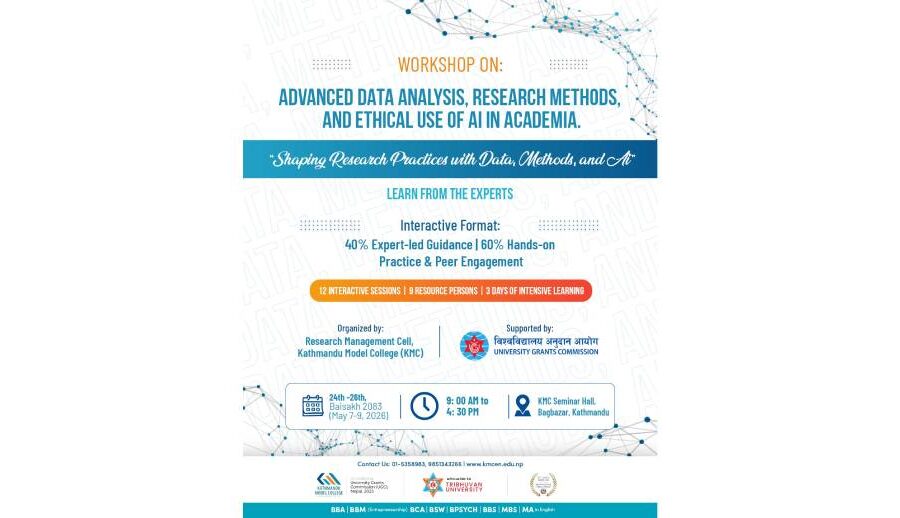
The Research Management Cell (RMC) of Kathmandu Model College (KMC) is organizing a three-day intensive workshop titled “Advanced Data Analysis, Research Methods, and Ethical Use of AI in Academia” from today to 26th Baisakh in support with the University Grants Commission (UGC), Nepal.
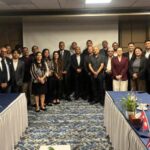
The workshop brings together faculty members, early-career researchers, and scholars from more than 15 institutions across the country, creating a dynamic platform for scholarly engagement, capacity building, and collaborative learning.
Designed to strengthen applied research skills, the program integrates quantitative, qualitative, and mixed-methods approaches within a unified and practice-oriented framework.
Emphasizing experiential learning, the workshop follows an interactive structure comprising 40 percent expert-led sessions and 60 percent hands-on practice and peer engagement.
Over three days, 10 distinguished resource persons will facilitate 12 intensive sessions covering research design, advanced data analysis, academic writing, and ethical research practices.
Participants will also receive practical exposure to widely used analytical tools such as PLS-SEM for structural equation modeling and ATLAS.ti for qualitative data analysis, along with other digital platforms that support contemporary research workflows.
As per the organizers, the workshop is thematically structured to ensure depth and progression. Day one focuses on quantitative research, including survey design, sampling strategies, structural equation modeling, and writing of quantitative findings.
Day two is dedicated to qualitative research, covering research design, data generation, coding, thematic analysis, and interpretation. Day three integrates mixed-methods research with manuscript development, publication strategies, and a focused session on the ethical use of Artificial Intelligence in academic work.
The workshop aims to strengthen participants’ understanding of diverse research paradigms, enhance analytical and interpretive skills, and build competence in producing high-quality, publication-ready research. It also promotes evidence-based academic practices, interdisciplinary collaboration, and the development of research networks across institutions.
With participation from over 15 institutions and more than 50 scholars, the workshop serves as a significant academic convergence platform, encouraging dialogue, knowledge exchange, and long-term collaboration among scholars.
The Research Management Cell of KMC has been consistently working to foster a dynamic and innovation-driven research culture within and beyond the institution. Through continuous collaboration with academic institutions and scholars, RMC seeks to strengthen research capacity, promote ethical scholarship, and contribute to Nepal’s evolving higher education landscape.
As higher education in Nepal continues to evolve, such initiatives play a critical role in enhancing research quality, strengthening ethical academic practices, and fostering sustained collaboration across institutions, contributing to a more rigorous and globally aligned research ecosystem in Nepal.
प्रकाशित: २४ बैशाख २०८३, बिहीबार