काठमाडौं ।
Huawei plans to use its new LogicFolding semiconductor technology in more smartphones as the Chinese technology giant works to strengthen its chip capabilities and gradually expand its presence in overseas markets, Richard Yu, Huawei’s consumer business chief, said.
Yu, who joined Huawei in 1993, said the company has invested more than 1.8 trillion yuan ($260 billion) in research and development between 2007 and 2025. Annual R&D spending has risen from about 10% of revenue in the early years to more than 20% in recent years.
The investment has focused on core information and communications technologies and basic research, helping Huawei build its own technologies, intellectual property and patent portfolio.
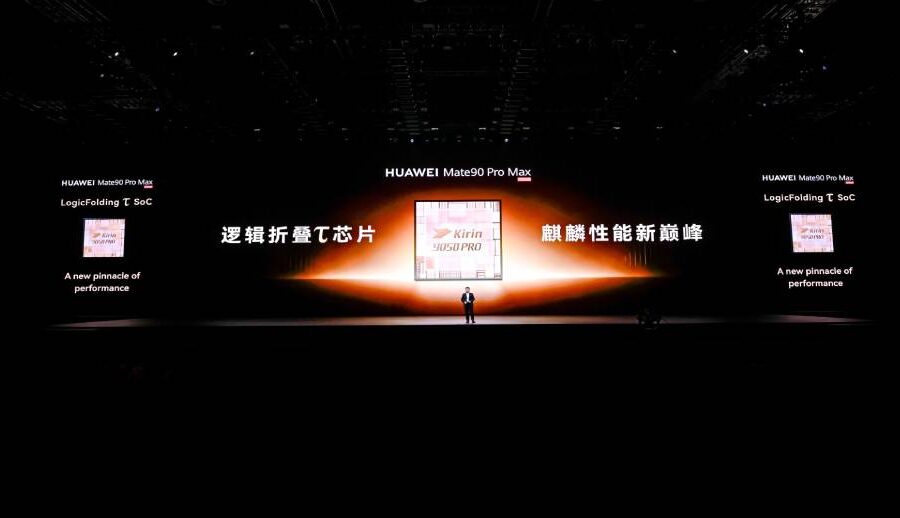
Huawei’s newly launched Mate 90 series uses the Kirin 9050 Pro chip, which the company says delivers 31% higher overall performance than its predecessor. The chip’s Balong modem, image signal processor, mobile security processor, Lingxi CPU, Maleoon GPU and NPU based on Huawei’s Da Vinci architecture were all designed by Huawei.
The Kirin 9050 Pro also incorporates Huawei’s LogicFolding technology, developed under what the company calls the Tau Scaling Law. The technology vertically stacks logic layers and uses high-density connections between layers to shorten critical paths and reduce latency. Huawei says the technology gives the chip strong AI processing capabilities, allowing the Mate 90 series to run a 30-billion-parameter mixture-of-experts model directly on the device.
Asked whether LogicFolding chips would be used in more smartphones, Yu said Huawei had already introduced the technology in the Mate XT 2 tri-fold smartphone and that “more of our phones will definitely use these LogicFolding chips in the future.”
Yu acknowledged that China’s advanced semiconductor production capacity remains constrained by rapidly growing demand. Huawei’s Ascend AI chips also rely on the same advanced production capacity, but the company has developed an internal requirements plan covering both AI and smartphone chips.
He said current capacity is generally sufficient for Huawei’s shipment needs, although rising memory prices over the past two years have affected smartphone sales volumes. Huawei hopes China’s semiconductor industry will expand production capacity to support more advanced products for both domestic and international markets.
Huawei has also developed its own operating system, HarmonyOS, after beginning its development in 2019. More than 90 million smartphones, PCs and tablets currently run HarmonyOS 6 and HarmonyOS 7, with the number expected to reach 100 million by the end of the year. The ecosystem has more than 450,000 apps and services, 11 million registered developers and more than 23,000 app innovation partners.
Yu said Huawei is considering gradually bringing HarmonyOS to global markets. The company, whose smartphone business was once the world’s largest, now sells only several million smartphones outside China annually but is seeking to rebuild its overseas presence step by step.
Huawei has maintained stronger positions in other product categories, including wearables, where Yu said it ranks first globally and in China. Its TWS earphones have also reached leading positions in several countries, while HarmonyOS-based tablets and mobile routers are gaining traction in overseas markets.
Yu said Huawei had reduced its dependence on U.S. technologies since 2019 by developing its own operating system, software tools and domestic supply chain. Huawei resumed domestic smartphone chip production in 2023 and now relies largely on China’s semiconductor, materials and manufacturing ecosystem.
प्रकाशित: १९ आश्विन २०८३, सोमबार