काठमाडौं ।
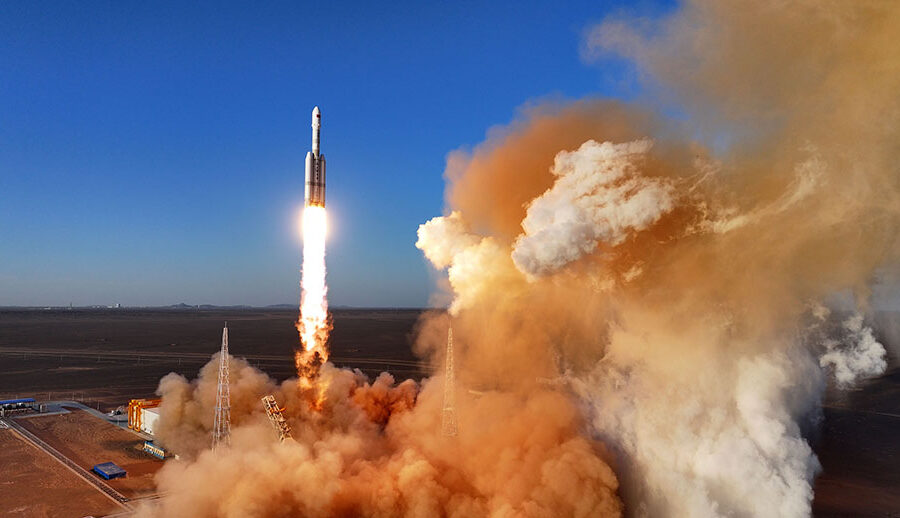
China on Monday launched a Lijian-2 Y1 carrier rocket with three satellites onboard.
The rocket blasted off at 7:00 p.m. (Beijing Time) from a commercial aerospace innovation pilot zone in northwest China and successfully sent the satellites into the planned orbit.
Among the satellites was the Qingzhou Cargo Spacecraft Test Vehicle, developed by the Innovation Academy for Microsatellites of the Chinese Academy of Sciences. The test flight carried 27 projects with a total payload of 1.02 tonnes and will conduct in-orbit tests at altitudes ranging from 200 to 600 kilometers.
The launch marked the first flight of the Lijian-2 rocket. According to the developers, it is China’s first launch vehicle using a “common booster core” design. The rocket stands 53 meters tall, with a liftoff weight of 625 tonnes and a thrust of 753 tonnes. It has a carrying capacity of 8 tonnes to a 500-kilometer sun-synchronous orbit and 12 tonnes for low Earth orbit.
“The Lijian-2 rocket marks a new milestone in the development of China’s next-generation space cargo transportation system,” said Yang Haoliang, commander of the Lijian-2 rocket. He noted that this marks a shift from reliance on a single rocket type or approach to a more systematic framework supported by multiple launch vehicles, enabling mutual backup and flexible deployment.
This systematic capability, he added, is fundamentally important for ensuring the long-term stable operation of the space station and for enhancing the safety and reliability of cargo transportation.
Yang said developers are currently working on reusable rocket technology. They have already completed initial tests on a smaller vehicle to verify key technologies such as controlled landing, and they plan to conduct further recovery tests later this year.
According to the developers, commercial rockets are expected to play a growing role in national space missions, helping to reduce costs and improve efficiency while maintaining high safety standards. Xinhua
प्रकाशित: १८ चैत्र २०८२, बुधबार