काठमाडौं ।
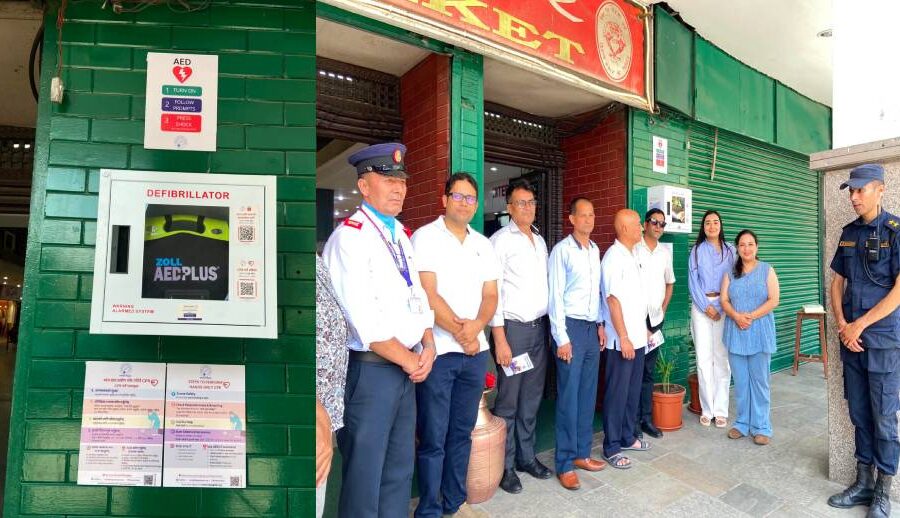
In another important step toward strengthening emergency preparedness and community-based lifesaving care in Nepal, a publicly accessible Automated External Defibrillator (AED) has been installed at Bishal Bazar, one of Kathmandu’s busiest commercial centers. This is the second public space AED that HAPSA Nepal has installed after they initiated the program at Tribhuvan International Airport a few months ago.
HAPSA Nepal is a local nonprofit organization dedicated to strengthening Nepal’s emergency care system through community-centered care, preparedness, and public health. America Nepal Medical Foundation (ANMF) provided support to HAPSA for this initiative.
The AED will be available for public use during emergencies, with monitoring and security support provided by Bishal Bazar Complex and Nepal Police Janasewa. HAPSA Nepal expresses its sincere gratitude to Bishal Bazar Complex for providing the space and support for this important lifesaving initiative. This initiative is part of a new collaboration to HAPSA Nepal and the Nepal Police. “Police officers are often the first to arrive when an emergency occurs. Equipping them with lifesaving skills and access to tools such as AEDs can make a critical difference in saving lives before patients reach a hospital,” said Dan Bahadur Karki, Inspector General of Nepal Police.
This installation builds on HAPSA Nepal’s ongoing efforts to improve survival after cardiac arrest in Nepal. The organization previously installed a public AED in the international departure area of Tribhuvan International Airport. Dr. Kamal Thapa, HAPSA Nepal’s vice president and CPR program lead said, “Shopping centers and commercial complexes are important locations for AED placement, as they serve thousands of visitors each day and can play a critical role in responding rapidly to sudden cardiac arrest.”
In Nepal, survival following out-of-hospital cardiac arrest is estimated to be Zero, largely due to delays in recognition, lack of early CPR, and limited access to defibrillation. AEDs are simple, safe, and highly effective devices that can restore a life-threatening heart rhythm by delivering an electrical shock when needed. The AED installed at Bishal Bazar includes clear visual instructions and a QR code linking to a brief instructional video, allowing bystanders to receive immediate guidance during an emergency.
This effort is part of HAPSA Nepal’s broader Nepal Lifesavers Program, a nationwide initiative aimed at building a culture of lifesaving response and strengthening the chain of survival throughout Nepal. To date, the program has trained more than 2,500-Armed Police Force personnel in CPR, launched school-based CPR education programs, begun collaboration with the Ministry of Education to integrate lifesaving skills into the national curriculum, made a Nepali CPR song, developed a community responder mobile application and CPR awareness campaign, and expanded public AED access in strategic locations across the country.
“ANMF is proud to support HAPSA in expanding public access to AEDs in Nepal. Every AED placed in a public space creates an opportunity to save a life,” said Dr. Narayan Neupane, President of the America Nepal Medical Foundation.
Dr. Ramu Kharel, founder and chief strategist of HAPSA Nepal, emphasized that the initiative represents more than the installation of a device. “This is about creating systems that allow lives to be saved before a patient ever reaches the hospital. By combining public access to AEDs with CPR training and community engagement, we can build a Nepal where more people survive sudden cardiac arrest,” he said.
प्रकाशित: १७ असार २०८३, बुधबार