काठमाडौं ।
The newly formed Government of Nepal, led by Prime Minister Balendra Shah, approved a 100-point good governance roadmap at its first Cabinet meeting on 27 March 2026.
Aligned with the manifesto of the Rastriya Swatantra Party, the roadmap was made public on 28 March 2026. It outlines a broad reform agenda, with a strong focus on digital governance, public service delivery, and administrative efficiency.
1. Digital Governance as a Central Reform Pillar
A central strength of the blueprint is its recognition of digital transformation as a foundational tool for improving governance. The roadmap introduces initiatives aimed at enhancing efficiency, transparency, and accessibility in public service delivery:
• Digital Personnel Management (Point 19): Developing the architecture for the Personnel Management Information System (PMIS) and updating digital profiles for all employees.
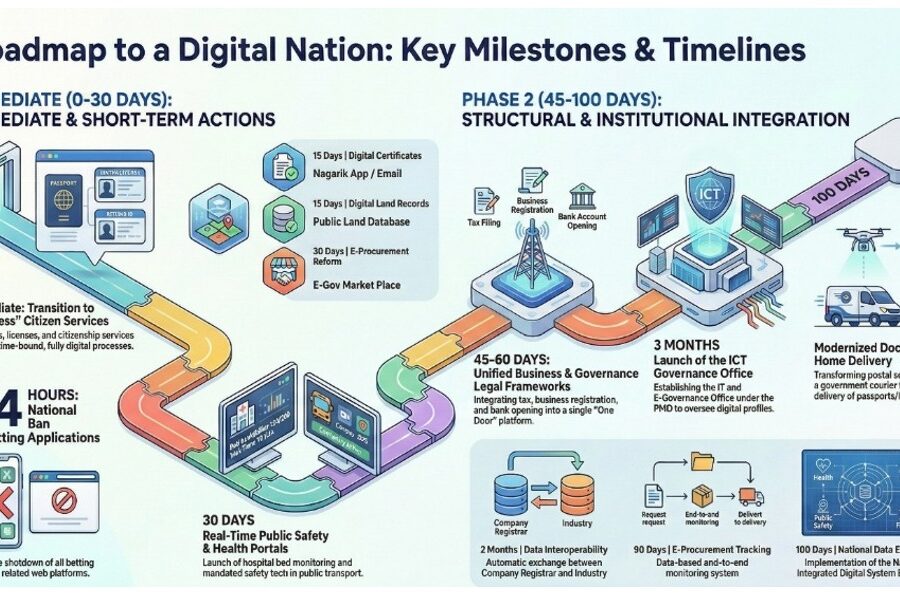
• Integrated Digital Services (Point 21): Delivering services, such as passports and citizenship, through an integrated digital system with a mandatory National ID.
• Faceless Service Delivery (Point 26): Transitioning passport, license, and citizenship services to a “faceless” and time-bound digital process.
• Grievance Redressal Mechanisms (Points 24 & 25): Operating a 24-hour national grievance system integrated with mobile apps, portals, and social media, alongside real-time citizen engagement through a revamped “Hello Sarkar” platform.
• Document Delivery and Office Management (Points 27 & 28): Modernizing postal services as a government courier and operationalizing the Government Integrated Office Management System (GIOMS) across agencies.
• Data Sharing (Point 29): Implementing auto-fill features in government portals to ensure citizens provide their details only once.
• Accessibility (Point 30): Ensuring government apps and portals are accessible to people with disabilities and those with limited technical knowledge.
• Online Applications and Appointments (Points 31 & 32): Strengthening online systems, such as the Nagarik App, for passport and license applications with integrated auto-fill and online appointment scheduling.
• Digital Authentication Systems (Point 33): Studying and implementing digital signatures, biometrics, and OTP-based systems for secure e-signatures.
• File Tracking (Point 34): Using an integrated system to track file status with automated alerts for delays.
• Digital Certificates (Point 35): Enabling the download of certificates via the Nagarik App or email.
• National Data Exchange Platform (Point 36): Implementing the National Integrated Digital System Blueprint and establishing a National Data Exchange Platform.
Together, these measures reflect a transition from fragmented e-governance practices to a more integrated, citizen-centric digital state architecture.
2. Institutional and Legal Reforms
The blueprint also seeks to address structural gaps in Nepal’s digital governance ecosystem:
• Data Governance and Protection (Point 37): Drafting a policy for digital governance and personal data protection.
• Independent ICT Regulatory Authority (Point 38): Establishing an independent regulator to ensure oversight, accountability, and standard-setting in the digital sector.
• ICT Governance Office (Point 39): Creating a central IT and e-governance office under the Prime Minister’s Office (PMO), while dissolving the existing Department of Information Technology (DoIT), to streamline oversight.
• Legislation (Point 40): Drafting the Information Technology and e-Governance Bill to modernize the legal foundations for digital governance.
• National Enterprise Architecture Framework (Point 41): Preparing the National Enterprise Architecture Framework.
• Ban on Betting Apps (Point 42): Taking immediate measures to block online betting and gambling platforms.
These initiatives demonstrate an awareness of the need for institutional coherence, regulatory modernization, and legal clarity.
3. Data-Driven Governance and Accountability
The roadmap emphasizes digital systems for monitoring, transparency, and financial accountability:
• Central Monitoring Dashboard (Point 64): Operating a central dashboard with Key Performance Indicators (KPIs) under the Prime Minister’s (PM) Delivery Unit.
• Integrated Digital Asset Registry (Point 45): Establishing a registry to track digital wallets, bank accounts, and investments, featuring red-flag alerts for suspicious transactions.
• E-Procurement Systems (Points 48 & 50): Reforming the Public Procurement Act to include concepts such as an e-Gov marketplace and implementing a data-based, end-to-end e-procurement monitoring system.
• Financial and Business Systems (Points 58, 79 & 80): Integrating one-stop business registration platforms, mandating e-billing, and implementing an action plan to automate tax administration and control leakage.
• Data Interoperability (Point 67): Ensuring interoperability for automatic data exchange between the Office of the Company Registrar and the Department of Industry.
These mechanisms align with global trends in evidence-based policymaking and real-time governance monitoring.
4. Sectoral Digital Reform
The blueprint expands digital reforms across critical sectors:
• Health (Points 85-A, 85-B, 85-D): Developing and deploying a free health portal for real-time monitoring of hospital bed availability, alongside a digital, integrated, and interoperable patient record system and a platform to track medicine stocks and pricing in government hospitals.
• Agriculture (Point 90-B): Operating a National Agricultural Market Information System to provide daily price updates via SMS and digital media.
• Land Governance (Points 91 & 92): Establishing GIS-based land records and digitizing public land registries to address ownership disputes and inefficiencies.
• Public Safety (Point 98): Mandating CCTV, dashcams, and SOS buttons in public transport and ride-sharing applications.
• Law Enforcement Technology (Point 94): Upgrading the Central Investigation Bureau’s digital infrastructure to improve investigative capacity.
5. Critical Gaps and Missing Dimensions
Despite its ambitious scope, the blueprint exhibits several significant gaps when examined from a digital rights and governance perspective:
a. Digital Inclusion, Literacy, and Institutional Capacity Gaps
The roadmap assumes a level of digital access and readiness that does not align with Nepal’s ground realities. Low internet penetration, coupled with persistent rural-urban, gender, and socioeconomic disparities, risks excluding marginalized groups, such as women, rural communities, persons with disabilities, and economically disadvantaged populations. This challenge is further compounded by a lack of adequate investment in digital literacy and capacity-building for both citizens and government officials.
Additionally, the plan has largely adopted a “digital-only” approach, which risks further alienating those affected by the digital divide. Existing institutional constraints, such as limited technical expertise, infrastructure unreadiness, and weak inter-agency coordination, are also insufficiently addressed. Together, these gaps undermine the effectiveness, inclusivity, and sustainability of the proposed digital governance reforms. To ensure equitable access and meaningful participation, the government must adopt a “Phygital” approach, integrating both digital and physical channels in public service delivery, to include all citizens and bridge these divides.
b. Absence of a Cybersecurity Framework
The roadmap does not articulate a comprehensive cybersecurity strategy. In the context of expanding digital infrastructure and data exchange systems, the absence of robust cybersecurity measures exposes government systems and citizens’ data to significant risks, including breaches, cyberattacks, and misuse.
c. Lack of Social Media Governance and Platform Accountability
There is no mention of policies addressing the regulation of digital platforms or platform accountability. This omission is particularly concerning given the rising challenges of online harms, misinformation, and technology-facilitated gender-based violence (TFGBV) in Nepal.
d. Weak Human Rights Safeguards and Risks of Centralized Data Infrastructure
Although the blueprint references data protection, it does not explicitly integrate core human rights principles, such as privacy, freedom of expression, and non-discrimination, into its digital governance framework. This gap is particularly concerning in light of the proposed National Data Exchange Platform and integrated digital registries, which indicate a move toward centralized data systems without adequate safeguards. In the absence of strong rights-based protections and oversight mechanisms, such centralization heightens the risks of surveillance, targeted monitoring, unauthorized access, and the misuse of personal data. The potential for “function creep” and state overreach could lead to the erosion of public trust and undermine citizens’ rights. Robust safeguards, accountability measures, and human rights–based frameworks are essential to mitigate these risks and ensure that digital governance advances, rather than threatens, democratic freedoms.
e. Limited Transparency and Public Participation
The roadmap lacks clear mechanisms for public consultation, stakeholder engagement, and transparency in the design and implementation of digital systems. While Point 100 encourages all stakeholders, including the government, private sector, and civil society, to cooperate in fulfilling national duties, it does not specify concrete processes or structures to ensure meaningful participation. Inclusive governance requires defined, actionable participatory approaches, particularly in digital policymaking, to foster accountability and trust.
f. Overlapping Initiatives and Lack of Continuity
The blueprint fails to acknowledge or align with existing initiatives, policies, and legal frameworks. Key instruments, such as the previously developed E-Governance Blueprint, the draft Personal Data Protection Policy that the Ministry of Communication and Information Technology (MoCIT) has opened for public consultation, and the existing E-Governance Board, are not referenced. This indicates insufficient attention to institutional and initiative continuity.
While the roadmap emphasizes the development of Digital Public Infrastructure (DPI), it does not clarify whether ongoing or planned projects by the World Bank or the Asian Development Bank (ADB) will be integrated. Such gaps risk overlapping efforts, resulting in unnecessary financial and human resource costs and highlighting weak institutional continuity. Overall, this omission creates the potential for duplication, fragmentation, and missed opportunities for coherent and effective digital governance.
g. Unrealistic Implementation Timeline
The timeline for implementation appears to be very short, which may pose significant practical challenges. It risks overburdening institutions and could lead to the bypassing of necessary procedural safeguards in the interest of rapid execution, potentially undermining the quality, accountability, and sustainability of the reforms.
6. Conclusion
The 100-point blueprint represents a significant step toward modernizing Nepal’s governance through digital transformation. Its focus on integrated services, data-driven decision-making, and institutional reform reflects a forward-looking approach. However, the absence of critical elements, such as robust cybersecurity measures, social media regulation, platform accountability, digital inclusion and human rights safeguards, reveals a significant gap between technological ambition and rights-based implementation. Furthermore, a reliance on a “digital-only” approach risks excluding marginalized communities and failing to bridge the existing digital divide.
The digital priorities also fail to adequately align with existing policies, institutions, and ongoing initiatives, raising concerns regarding duplication of efforts, weak institutional continuity, and the inefficient use of public resources.
To achieve its intended outcomes, the blueprint must be complemented by a comprehensive, inclusive, and rights-respecting digital governance framework that addresses both structural inequalities and emerging digital risks. Digital Rights Nepal (DRN) calls on the government to update the blueprint to address these identified gaps and challenges. Success will require collective action through a multi-stakeholder approach involving the government, civil society, the private sector, and the technical community. In this regard, DRN expresses its willingness to collaborate with the government to support the development and implementation of a robust, rights-based digital governance framework for Nepal.
प्रकाशित: २२ चैत्र २०८२, आईतवार