काठमाडौं ।
The future of cloud computing is being reshaped by AI-driven agents, according to a senior technology leader from Genese Solution, a UK-based IT and cybersecurity consulting firm.
Speaking at a virtual Nepal meetup of the Amazon Web Services User Group (AUG) titled “AWS re:Invent 2025 Recap: Global Highlights and Local Insights,” Niranjan Kunwar, Global Chief Technology Officer (CTO) and Chief Information Security Officer (CISO) of Genese Solution, said that Amazon Web Services (AWS) is clearly moving toward an agent-first cloud model.
Kunwar, who attended AWS re:Invent in Las Vegas alongside Genese Solution CEO Anjani Phuyal, said AWS is embedding AI agents directly into how cloud platforms are built, operated, and secured. “AWS made it very clear at re:Invent that AI is no longer an add-on in the cloud,” Kunwar said. “It is becoming part of the operating system itself. We are moving from humans operating cloud systems to humans supervising intelligent agents that operate the cloud.”
Cloud Operations Enter the Agent Era
Kunwar explained that AWS announced a new generation of AI agents designed to support the entire DevOps lifecycle from architecture design and code generation to system monitoring and production support.
“DevOps agents can generate code, answer architectural questions, monitor production environments, and assist teams end-to-end,” he said. “Security agents continuously monitor environments, detect suspicious behavior, and can trigger remediation in real time, shifting security from a reactive to a proactive model.”
He added that modernization-focused agents are particularly impactful for organizations managing complex legacy systems, helping them accelerate cloud transformation at scale. “The larger message is clear,” Kunwar said. “The future of the cloud is agent-powered and it is already here.”
These AI agents are powered by AWS’s newly announced Nova 2 model family, which comes in multiple variants optimized for different workloads, including reasoning, automation, and large-scale orchestration.
Global Recognition for Nepal-Built AI Product
During the session, Kunwar also highlighted GUMP, an AI-powered campaign platform developed by Genese Solution. GUMP was recently recognized as one of the top five Agentic AI solutions for the SMB segment at the AWS Shark Tank competition, co-hosted by AWS and Ingram Micro during AWS re:Invent.
GUMP helps businesses engage customers through timely, relevant, and personalized messaging using AI-driven campaign orchestration. Genese Solution competed alongside companies from New Zealand, Australia, Canada, and the United States.
“This recognition shows that engineering and product innovation from Nepal can compete at a global level,” Kunwar said. “We are proud that the software built by our teams is being taken seriously in the international marketplace.”
Broader Insights from the AWS Community
The event also featured Amit Joshi, Solution Architect at Leapfrog, who shared broader insights from AWS re:Invent. “Python is becoming the new assembly language,” Joshi said. “Security now starts at prompt time, and governance is moving upstream. Organizations need to adopt AI agents carefully, choose the right models, and over-invest in validation.”
Roshani Shrestha, Information Security Analyst at F1Soft and a member of AWS User Group Nepal, shared her journey of attending AWS re:Invent through a global fellowship program. “I was an intern when I applied for the fellowship,” she said. “Being able to attend re:Invent in Las Vegas was a dream come true. I strongly encourage students and early-career professionals to apply when these opportunities are announced.”
Building Global Capability from Nepal
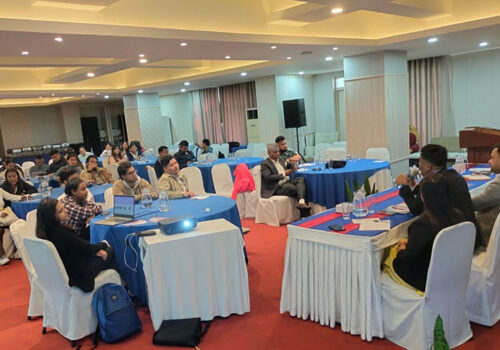
The virtual meetup brought together AWS User Group members, technology professionals, industry experts, and academics to discuss global cloud trends and their relevance to Nepal’s growing technology ecosystem. “Now is the time to learn, build, and demonstrate that we can deliver world-class cloud and AI innovation from Nepal,” Kunwar said.
प्रकाशित: ११ पुष २०८२, शुक्रबार